Substrate-Driven Localization Gaps in Pipe Crack Detection
University of Santo Tomas, Manila, Philippines
📄 Abstract
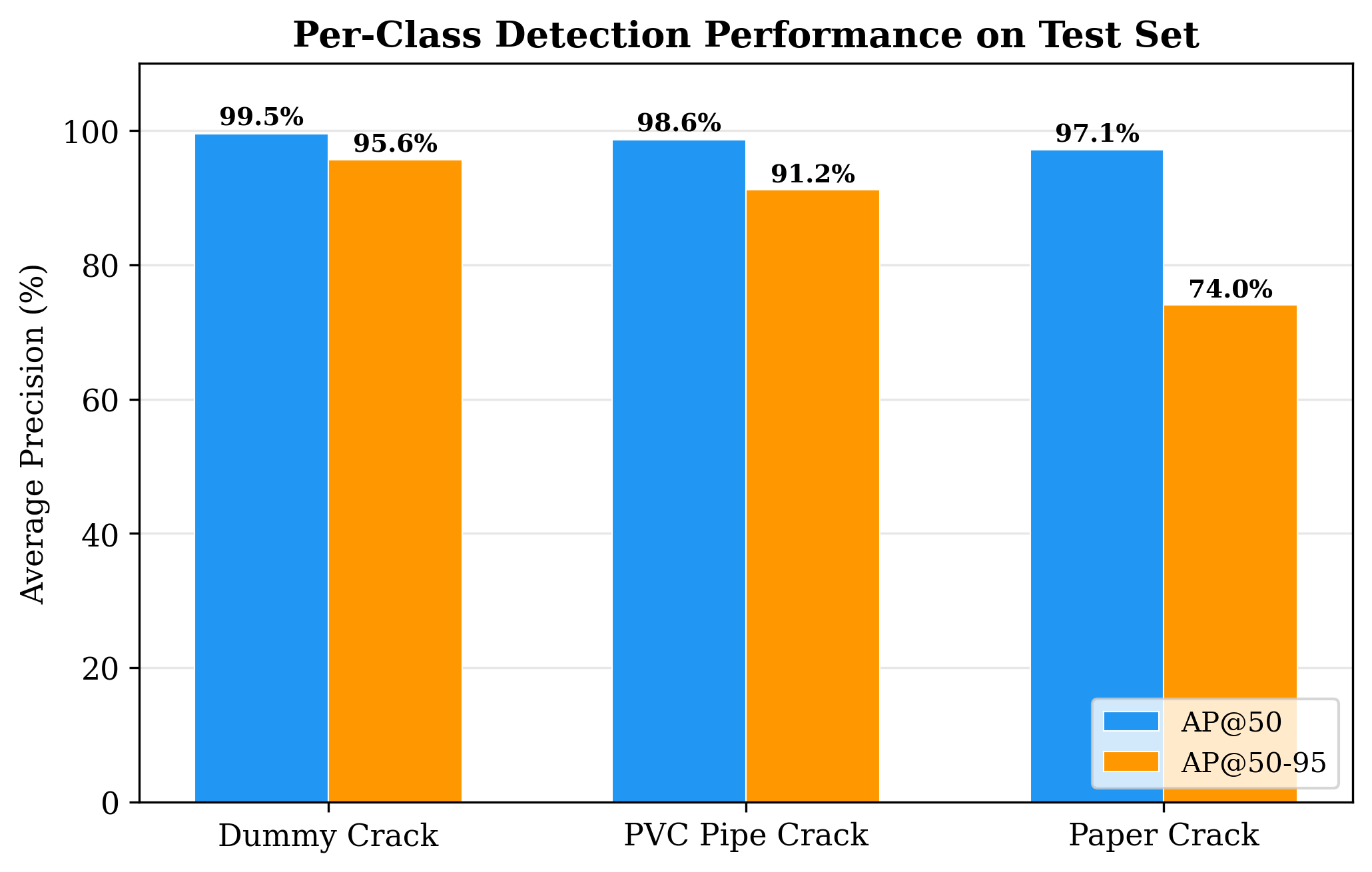
Automated visual inspection of piping systems is essential for structural integrity monitoring, yet the effect of pipe surface properties on detection accuracy remains underexplored. This paper examines whether the visual complexity of the pipe surface degrades crack detection accuracy, even under class-balanced training conditions. Three crack types were created on surfaces ranging from smooth PVC to textured tissue paper, with 400 labels per class. Two object detection models, YOLO-World XL and YOLOv8x, were each trained five times with different random seeds on an NVIDIA DGX A100. YOLO-World XL achieved an overall mAP (IoU 0.50–0.95) of 0.863, but per-class performance varied widely: 94.2 percent for cracks on smooth PVC versus only 73.9 percent on textured tissue, a gap of over 20 percentage points present in both models. An analysis across IoU thresholds revealed that the model can detect cracks on textured surfaces (97.1 percent AP at IoU 0.50) but fails to produce precise bounding boxes, dropping 23.1 percentage points at stricter thresholds. Three data augmentation strategies (CutMix, multi-scale training, and their combination) were tested but none significantly reduced the gap (all p > 0.05 after Bonferroni correction). These results indicate that surface texture, rather than data quantity or model choice, is the primary factor limiting detection accuracy on challenging pipe materials.
🗂️ Dataset
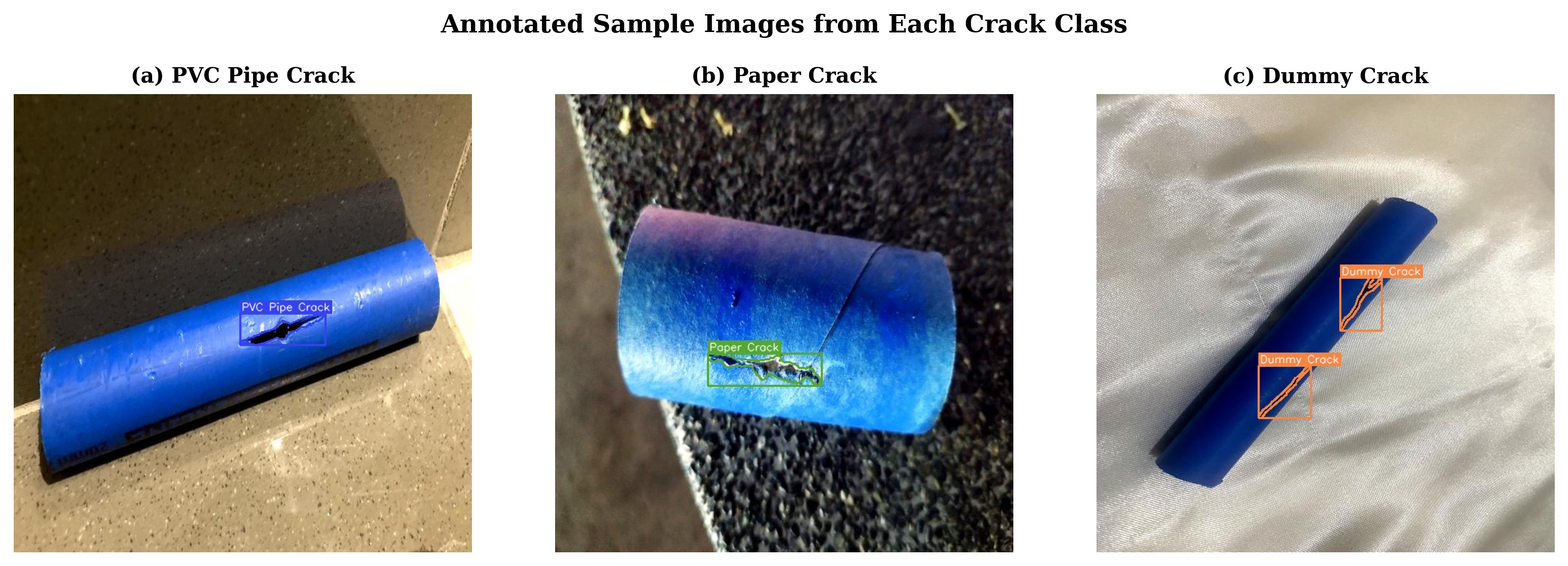
The dataset is purpose-built as a controlled texture gradient: three crack types are placed on surfaces that progress from smooth, low-texture PVC to porous, high-texture tissue paper. Because every class carries an identical number of labels (400 each), the dataset isolates substrate visual complexity as the variable under study, holding data quantity constant so that any per-class performance gap can be attributed to surface texture rather than label imbalance.
Class Composition
| Class | Substrate | Surface texture | Labels | AP50:95 |
|---|---|---|---|---|
| Dummy crack | Smooth PVC sheet | Low | 400 | 94.2% |
| PVC pipe crack | PVC pipe (real fractures) | Low / curved | 400 | 90.8% |
| Paper crack | Tissue paper | High / porous | 400 | 73.9% |
AP is YOLO-World XL, mean of 5 seeds. Detection quality tracks the texture gradient even though label counts are equal.
Splits
| Train | Val | Test | Total | |
|---|---|---|---|---|
| Images | 2,292 | 217 | 108 | 2,617 |
| Classes | 3 | 3 | 3 | 3 |
Specifications
- TaskObject detection (bounding boxes)
- Annotation formatYOLO (axis-aligned boxes)
- Training resolution640 × 640 (960 for multi-scale)
- Annotations1,200 total (400 per class, balanced)
- SourceRoboflow Universe (workspace gazxard, v1)
- LicenseCC BY 4.0
Full images are hosted on Roboflow Universe (not bundled in the repository); the repo ships the data.yaml configuration and class definitions for reproducible training.
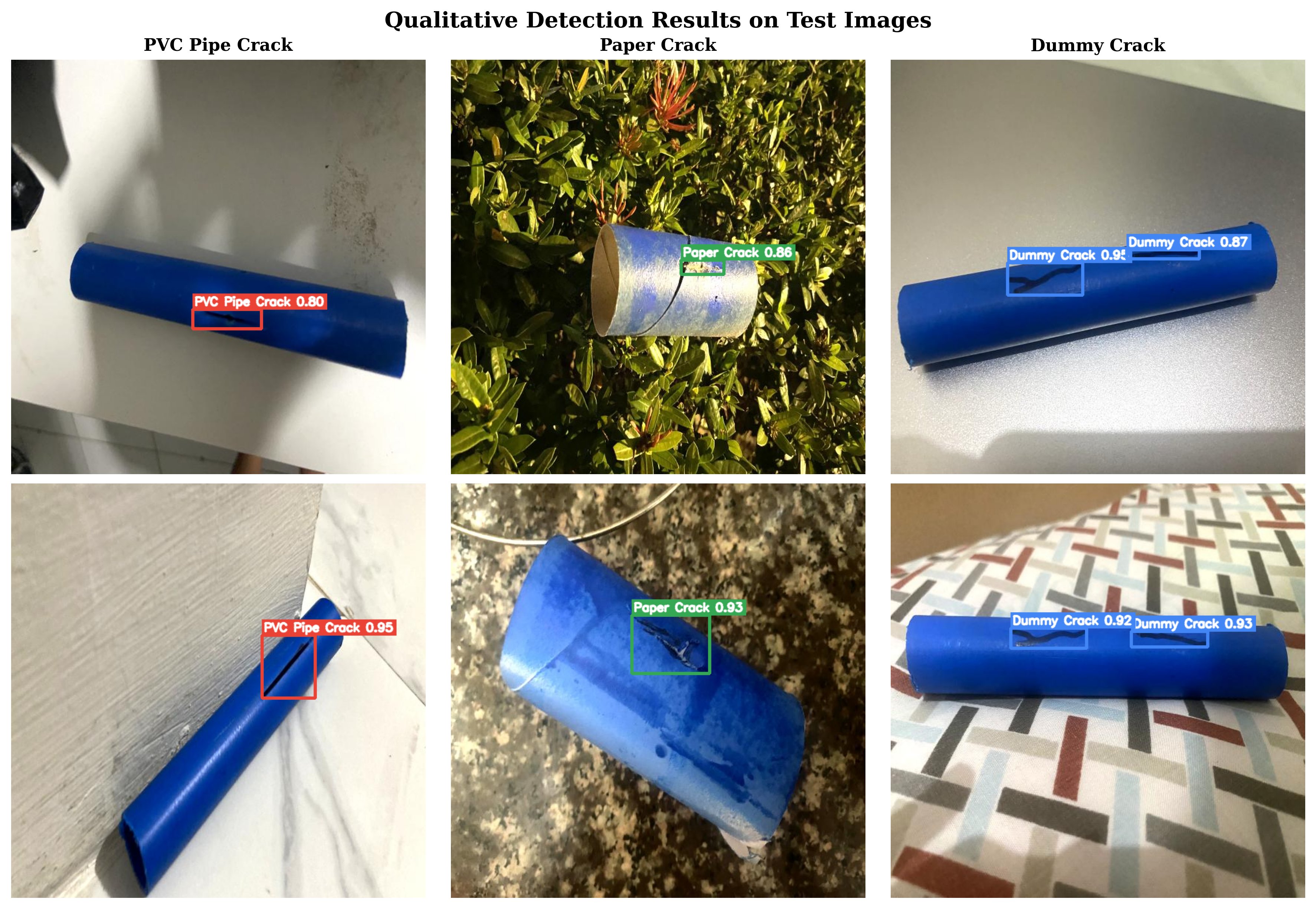
🔍 Qualitative Results
Localization Gap Across IoU Thresholds
Dataset Samples
Qualitative Detections
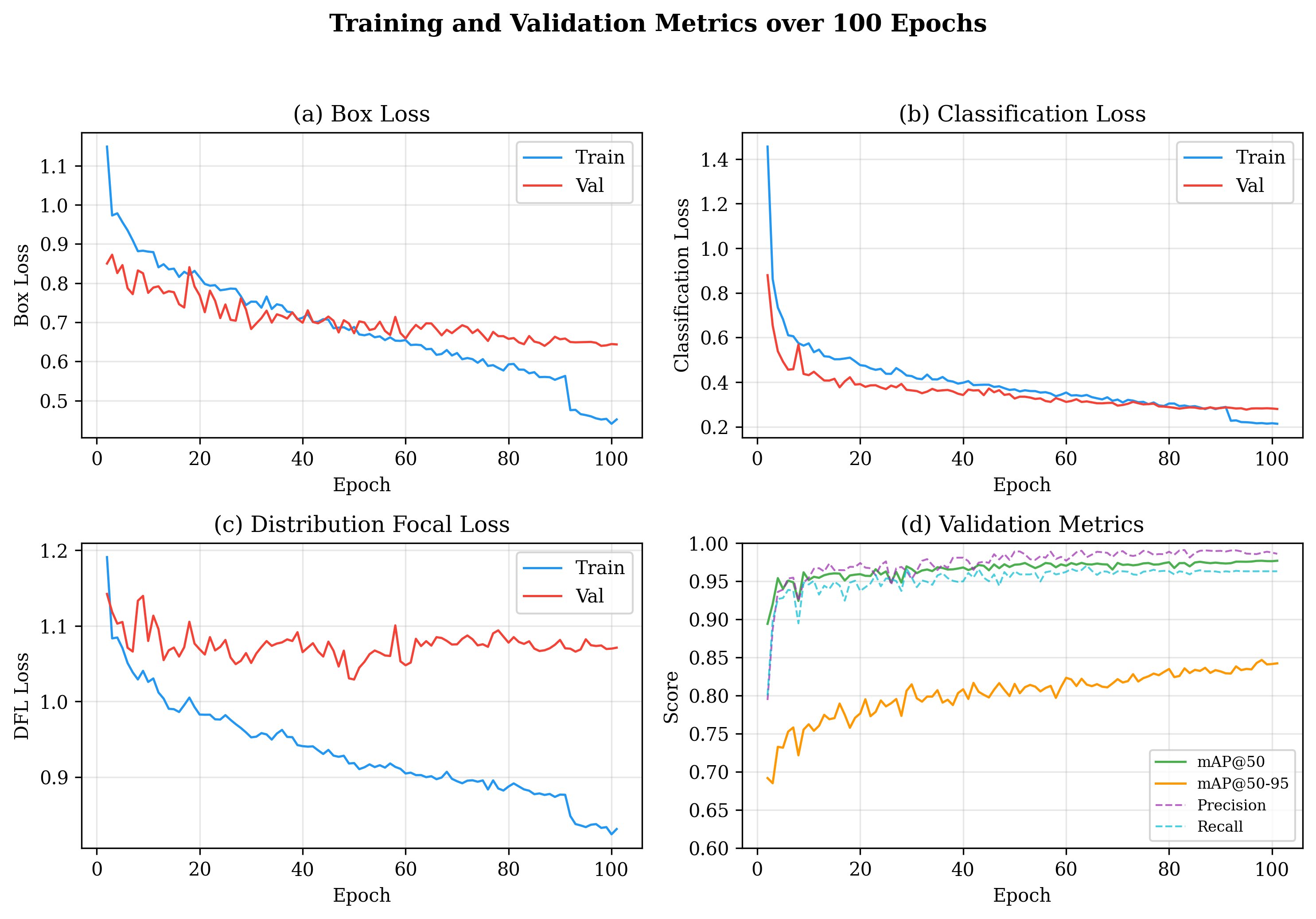
📊 Key Results
Mean of 5 random seeds. All classes have identical training-label counts (400 per class).
YOLO-World XL
smooth PVC
textured tissue
persists under all aug.
Substrate-Dependent AP Gap
| Class | AP50 | AP50:95 | Loc. gap |
|---|---|---|---|
| Dummy crack (smooth) | 99.5% | 95.6% | 3.9 pp |
| PVC pipe crack | 98.6% | 91.2% | 7.4 pp |
| Paper crack (textured) | 97.1% | 74.0% | 23.1 pp |
YOLO-World XL, best run (seed 42), test split. Detection is reliable at IoU 0.50; the gap is a localization failure that grows at stricter thresholds. Across 5 seeds the per-class AP50:95 means are 94.2 / 90.8 / 73.9.
Model Comparison (n = 5)
| Metric | YOLO-World XL | YOLOv8x | Cohen's d |
|---|---|---|---|
| mAP50:95 | 0.863 | 0.855 | 1.35 |
| mAP50 | 0.986 | 0.981 | 1.31 |
| Recall | 0.980 | 0.969 | 1.40 |
| F1 | 0.983 | 0.974 | 1.44 |
Paired t-test. Cohen's d > 0.8 = large effect, but the substrate gap appears in both.
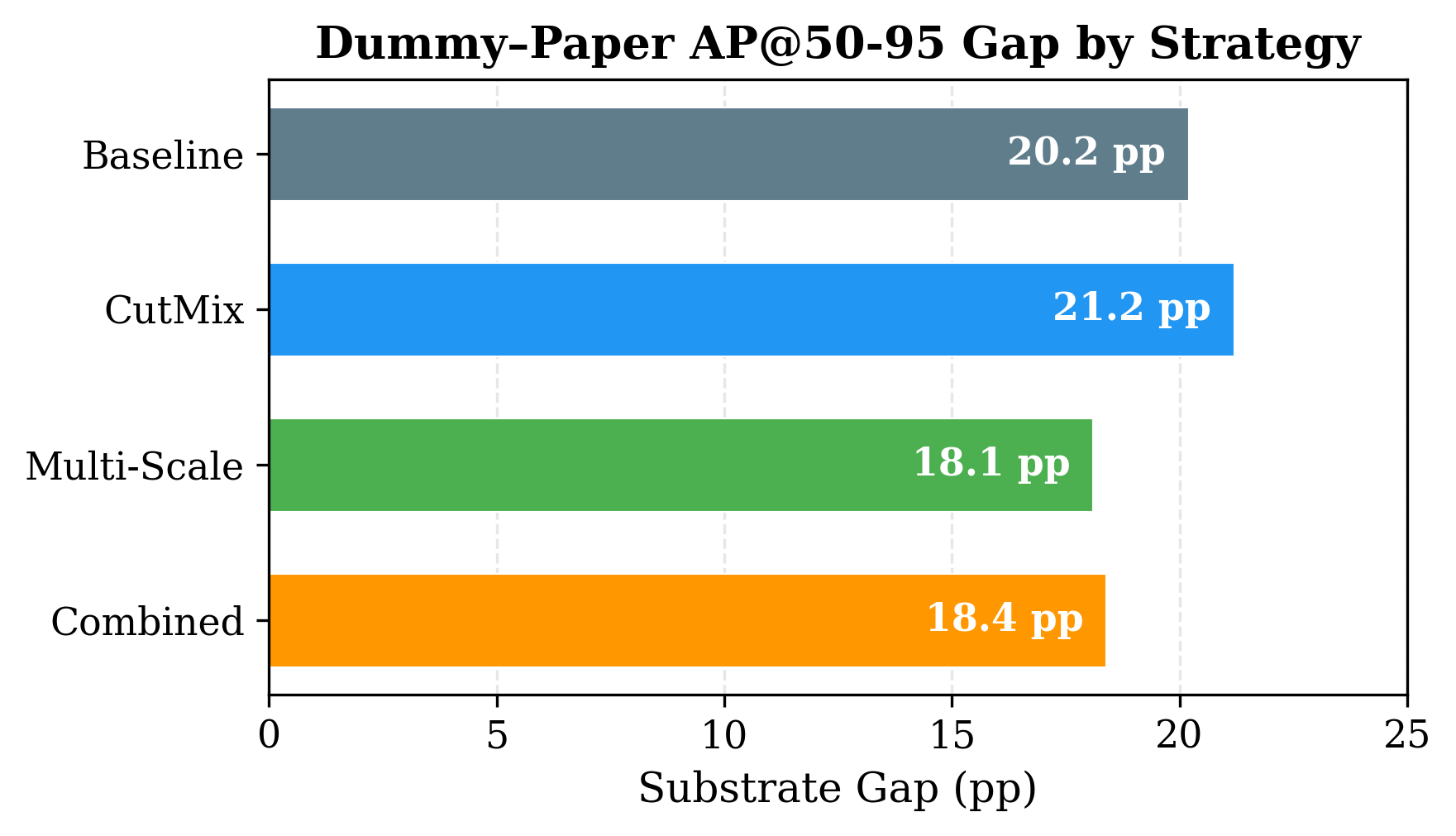
Mitigation Strategies: None Close the Gap
| Strategy | mAP50:95 | Substrate gap | p (gap) |
|---|---|---|---|
| Baseline | 0.863 | 20.2 pp | — |
| CutMix | 0.840 | 21.2 pp | 0.562 |
| Multi-scale | 0.839 | 18.1 pp | 0.334 |
| Combined | 0.805 | 18.4 pp | 0.102 |
None significant after Bonferroni correction (α = 0.0167). The gap is a fundamental, substrate-driven localization challenge.
📝 BibTeX
If you find this work useful in your research, please consider citing:
🙏 Acknowledgment
This research was conducted at the Department of Electronics Engineering, Faculty of Engineering, University of Santo Tomas. We gratefully acknowledge and sincerely thank the SafeGuard project of Dr. Anthony James Bautista for funding this research and making this work possible.